ETG · GP Expedite JC1 Mid-Year Programme · 2026 Promos Singapore — Coronation · Kovan · Zoom
GP Expedite · JC1 Mid-Year Programme
GP Expedite · JC1 Mid-Year · Promos 2026

You've missed time.
You haven't missed anything.

The complete JC1 General Paper programme for students joining mid-year. Live weekly lessons. Recorded backfill for every chapter since January. Post-Promo Term 4 Headstart. Every GP crashcourse — included.

58 JC1 Lessons
8 Crashcourses
12 Themes
$3,080 One Bundle
What's Included
Everything.
  • i.Live weekly lessons
  • ii.Recorded backfill
  • iii.Every crashcourse
  • iv.Term 4 Headstart
One programme · One price
01 — The Problem

You're not behind because you're slow. You're behind because you joined late.

Almost every JC1 student who reaches mid-year unprepared for GP is in the same position. The programme started in January. The themes have been building. The essays have been writing themselves into other students' habits. Now Promos are weeks away — and there are three specific gaps to close, in a defined order.

i.

You haven't written enough essays.

Most JC1 students arriving at Promos under-prepared have written 5 to 7 GP essays in total. Strong students at this stage have written 25 to 30, every one returned with structured paragraph-level feedback. The gap is not intelligence. It is reps.

ii.

You don't know what to study.

The 12 GP themes are not all equally testable for Promos. Without a structured filter — built from past-year question history and mock paper data — students burn time reading articles on topics that won't appear in any meaningful form, while neglecting the ones that almost certainly will.

iii.

The Application Question is 12 marks. And the structure is the hardest thing to teach yourself.

The AQ is the single most differentiating component in Paper 2. It is also the component students are most likely to arrive at without a structured method — a sample answer or two, a few rules of thumb, and an attempt to assemble a response on the day. By Promos, the AQ alone can decide a grade band.

These three problems are real. They are also specific — and that is the important part. A specific problem has a defined solution. GP Expedite is built around that solution: the structured catch-up that closes the gap before Promos, while keeping the JC1 curriculum intact for everything that comes after.

Behind isn't broken. It's a problem with a defined solution.

Every JC1 student who joins ETG mid-year arrives with the same gap. The programme is built to close it — not by skipping content, not by cramming summaries, but by giving you the actual lessons you missed.

There's a particular kind of GP panic that strikes around June or July. The Promos are real. The gap between what you've done and what you should have done is real. And the standard advice — just practise more essays, just read more news — is not useful when there is no structured way to practise and no curated filter on what to read. You don't need more reading. You need the programme itself, made accessible to you mid-year, with the missing pieces in place.

That is what GP Expedite is mechanically built to deliver. Not a discount. Not a sample. Not a shortcut. The full JC1 programme, joined late, with four specific components that work together.

How catch-up actually works
  1. Recorded video lessons for every chapter since January. Watch at your own pace, in any order. This is not abridged content — it is the same recorded material from the live class.
  2. Every term textbook in the cycle, yours from day one. Term 1A, 1B, 2 textbooks — the same in-house textbooks enrolled students received term by term.
  3. Live weekly lessons from the moment you join. Same class, same teaching, same essay marking and feedback as students who started in January.
  4. Every GP crashcourse — March, June, September. The March crashcourse is delivered as recorded videos plus its textbook, since it has already run. June and September are attended live.
  5. Term 4 Post-Promo Headstart. Once Promos are over, the programme continues into JC2 prep — so you don't fall behind a second time.

None of this is improvised. The recorded backfill exists because the live classes are recorded as part of standard programme operations. The textbooks exist because they are produced every term regardless. The crashcourses exist because they are run every year for the regular cohort. The programme is built to absorb mid-year joiners. GP Expedite is the name we give the bundle when you take all of it at once.

03 — What's Included

One bundle. Four components.

GP Expedite is the entire JC1 General Paper programme, joined late — assembled as a single bundle so that every piece of the curriculum is intact, not patched together.

01.
Live Lessons

Live weekly lessons. From the day you join.

Two-hour weekly lessons at Coronation Plaza, Upper Serangoon / Kovan, or Zoom — same JC1 timings as the regular cohort. Same content. Same teaching. Same essay marking and feedback.

From the moment you register, you are in the live cohort: monthly essay practice, in-class comprehension drills, AQ-specific instruction, and current-affairs integration woven into every theme.

Includes
  • Weekly 2-hour lessons
  • Monthly essay practice with feedback
  • AQ technique instruction
  • Mock Promo paper preparation
02.
Recorded Backfill

Every chapter since January. Recorded. Yours.

Watch the recorded video lessons for every theme covered before you joined. The same material the regular cohort sat through live, accessible at your own pace and in any order. Term 1A, Term 1B, and Term 2 lessons — the chapters that built the foundation.

Each recorded lesson is paired with its in-house textbook — produced for that specific term, sent to you on enrolment. You are not piecing the programme together from notes. You are watching the actual lessons.

Includes
  • Recorded videos for missed lessons
  • Term 1A, 1B, and Term 2 textbooks
  • Watch at your own pace
  • Same content as live classes
03.
Every Crashcourse

March, June, September. All eight. Included.

Every GP crashcourse run in 2026 is included in your enrolment. The March crashcourses — both the Essentials Crashcourse 1 (content) and the GP Skills Crashcourse (essay writing, comprehension, AQ technique) — are delivered as recorded videos plus their textbooks. The June and September crashcourses are attended live alongside the regular cohort.

This is the structured consolidation layer the regular cohort relies on across the year. As an Expedite student, you don't pay for any of them separately.

Crashcourses
  • GP Essentials Crashcourse 1 (March)
  • GP Skills Crashcourse (March)
  • GP Essentials Crashcourse 2 (June)
  • Level 1 Compre & Essay Bootcamps (June)
  • September Study Rush
  • Level 2 Compre & Essay Bootcamps (September)
04.
Headstart

Post-Promo Term 4 Headstart. Into JC2.

Once Promos are over, the programme does not pause. Term 4 Headstart lessons (October onwards) cover JC1 consolidation and the first JC2 themes — so you enter the new academic year already ahead, not catching up a second time.

This is the difference between a Promo-prep package and a JC1 programme. Expedite is the second one.

Bridges Into
  • Term 4 Headstart lessons
  • Pre-JC2 essay technique refinement
  • JC2 theme preview
  • Smooth handover to JC2 cohort
04 — By the Numbers

The bundle, in figures.

JC1 Lessons (live + recorded)
58

Across the full JC1 calendar — live lessons from your join date, plus recorded backfill for everything since January.

Crashcourses Included
8

GP Essentials × 2, GP Skills Crashcourse, Level 1 Compre & Essay Bootcamps, September Study Rush, Level 2 Compre & Essay Bootcamps. All in.

Themes Mastered
12

Six core JC1 themes plus six further themes — covering both papers and the full JC1 syllabus arc.

Programme Fee
$3,080

Single bundled price. Includes everything above plus all in-house textbooks and Term 4 Headstart — no further fees through to JC2.

Ready When You Are

The bundle is built. The programme is running. Join the cohort.

05 — Every Crashcourse

Eight crashcourses. All included.

Every GP crashcourse and bootcamp we run for the JC1 cohort in 2026, included at no additional cost. The two March crashcourses, having already taken place, come as recorded videos plus their textbooks — the same material the live attendees received.

March17 March
Already Conducted

GP Essentials Crashcourse 1 — Society, Tech, Politics.

Three content sessions across one day covering Society and Culture, Science and Technology, and Economics and Politics. The pre-Promo content foundation — the major essay-testable themes for the JC1 first half consolidated into a single intensive.

Delivered as recorded videos + crashcourse textbook
Included
March18 March
Already Conducted

GP Skills Crashcourse — Essay, Comprehension, AQ.

Three skills sessions across one day. Essay Writing technique (paragraph structure, evaluation depth, argument calibration), General Comprehension Skills (passage analysis, inference, summary technique), and Application Question methodology — taught as a structured discipline, not as fragments.

Delivered as recorded videos + crashcourse textbook
Included
June22 June
Live · Coronation Plaza / Zoom

GP Essentials Crashcourse 2 — Environment, Arts, Global Affairs.

Three sessions covering The Environment (Extinction, Biodiversity, Geoengineering), Arts and Culture (Artistic Appreciation in Singapore), and Global and Local Affairs (Mr President — Trump and the world).

Attend live in person or via Zoom
Included
June23 June
Live · Coronation Plaza / Zoom

Level 1 Compre Bootcamp — Six comprehensions in one day.

An intensive single-day bootcamp covering six full comprehensions. All passages are assigned as homework before the bootcamp; the day is spent walking through technique, marking schemes, and the AQ structure on each.

Included
June24 June
Live · Coronation Plaza / Zoom

Level 1 Essay Bootcamp — Eight essays in one day.

An eight-essay deep dive in a single day. Essays are pre-assigned; the bootcamp focuses on argument structure, paragraph architecture, and band-specific feedback across the full set.

Included
September5 September
Live · Upper Serangoon / Zoom

GP September Study Rush — Four sessions, one day.

The pre-Promo consolidation: Society and Culture, Science and Tech, Economics and Politics, and Global Affairs and Topics of Local Concern — back-to-back, with the year's most likely Promo themes prioritised.

Included
September8 September
Live · Upper Serangoon / Zoom

Level 2 Compre Bootcamp — Comprehension, sharpened.

The advanced comprehension bootcamp. Pre-assigned passages, a full day of marked-paper walkthroughs, and AQ technique calibrated for Promo and prelim-level questions.

Included
September12 September
Live · Upper Serangoon / Zoom

Level 2 Essay Bootcamp — Eight essays. The final pass.

The pre-Promo essay bootcamp. Eight essays at a higher difficulty calibration, with feedback focused on the band-3-to-band-4 jump and the band-4-to-band-5 jump — the two transitions that decide outcomes.

Included

The two March crashcourses ran on 17 and 18 March 2026. Expedite students joining after that point receive the full recorded videos plus the printed crashcourse textbooks — the same material every live attendee received. Nothing is missed.

06 — Inside the Curriculum

What an ETG GP chapter actually looks like.

Each in-house chapter is a 3,500–5,000-word piece of analytical writing — built from primary sources, anchored in Singapore, and ending with a defensible thesis the student can argue under exam conditions.

Below — Three Chapters from the 2026 Syllabus
i. Environment Biodiversity & Geoengineering
ii. Economics & Politics Mr President — Trump & Singapore
iii. Arts & Culture Arts Hub or Arts Venue?
i.
Environment · Chapter Length ~3,800 words

Biodiversity and Geoengineering — two topics, one frame.

"How much should humans remake nature, on whose authority, and who pays the cost?"

Most GP material on the environment treats biodiversity loss and climate change as separate topics, lists pros and cons, and calls it balance. This chapter argues they are variations of the same underlying question. It uses Singapore's 2024 mass coral bleaching event, the Cross Island Line tunnel debate, and the contrast between Make Sunsets (a private actor conducting unilateral stratospheric experiments) and SCoPEx (an academic team unable to get permission for theirs) to expose the geoengineering governance vacuum from both directions.

The deepest essay-worthy point is distributive justice: the countries with the most power over the climate system are usually not the ones who will live with the consequences. Students leave with at least one defensible position — not a survey of "different views".

Singapore Case Studies
  • 2024 mass coral bleaching eventWhy frequency matters more than recovery rate — every 25–30 years historically, every 6 years now.
  • Cross Island Line and the 70m tunnelConservation through expensive engineering is a luxury good. The Singapore approach is not exportable to most of the tropical world.
  • 37% of Singapore's native species lost since 1819Less than 0.2% of original primary forest remains. Carbon tax: S$45/tonne in 2026.
  • Make Sunsets vs SCoPExThe geoengineering governance vacuum, exposed from both directions.
Frameworks Taught
  • Calibration framework for "too much" questions
  • Threshold framework for "to what extent"
  • The "I love nature" Band 3 trap
  • Band 1 vs Band 2 paragraph-level worked contrast
Past-Year Questions Equipped For
  • 2025 Q3Too much concern about the environment?
  • 2024 Q3Protect environment without slowing development?
  • 2022 Q9Individuals or governments responsible?
  • 2020 Q3Climate change requires economic sacrifice?
  • 2019 Q6Saving endangered species?
ii.
Economics & Politics · Chapter Length ~3,580 words

Mr President — Trump, the world, and Singapore in a post-rules era.

"Is Trump the cause of global disorder, or its symptom?"

A non-partisan analytical framework for thinking about the most consequential political phenomenon of a JC student's lifetime. The chapter teaches structural analysis (the demographic realignment that produced 2024), continuity-and-change reasoning (Trump 2.0 was largely predictable from Trump 1.0), and the discipline of steelmanning the opposition — distinguishing legitimate grievances from the methods of address.

It then closes by mapping the analysis onto Singapore's "refuse to choose" doctrine, identifying the three scenarios in which the doctrine breaks: a Taiwan crisis, secondary sanctions, and technology bifurcation. Singapore is the position from which the analysis is conducted, not a footnote at the end.

Case Studies (with Singapore Lens)
  • Liberation Day & the Tariff Revolution (April 2025)Plus the Supreme Court's 6-3 IEEPA ruling and the Section 122 pivot. Singapore's response: 10% then 15% tariffs.
  • The 2026 Iran warOperation Midnight Hammer; the closure of the Strait of Hormuz; the consequences for small open economies.
  • PM Wong: "rules-based globalisation is over"The strategic implications for a country that built its prosperity on those rules.
  • The "refuse to choose" doctrine under pressureFM Vivian Balakrishnan's framing — and three scenarios where it breaks.
Frameworks Taught
  • Cause-vs-symptom (transferable)
  • Continuity-and-change analysis
  • Method-or-madness calibration
  • Steelmanning the opposition
  • Singapore as analytical lens, not surface mention
Past-Year Questions Equipped For
  • 2025 Q9Small countries fear globalisation?
  • 2024 Q10Is interference ever right?
  • 2023 Q9Small countries no influence?
  • 2022 Q8Democracy worst form?
  • 2025 Q6Freedoms in times of crisis?
iii.
Arts & Culture · Chapter Length ~4,800 words

Arts Hub or Arts Venue? Artistic appreciation in Singapore.

"Has Singapore built an arts hub, or just a collection of arts venues?"

Singapore has world-class arts infrastructure — the $600M Esplanade, the National Gallery, three Renaissance City Plans, the new University of the Arts Singapore. But has it built audiences for it? The chapter uses the SG Culture Pass (September 2025) as its entry point: a state intervention that treats price as the obstacle when NAC's own surveys identify time, companionship, and unfamiliarity as the real barriers.

From there, it examines career economics, the state-as-patron tension (using two canonical Singapore cases), and the structural role of the education pipeline. The strongest essay position holds two truths simultaneously: the infrastructure is a genuine achievement, and the gap between infrastructure and appreciation is also genuine — and it is the gap, not either pole alone, that defines the question.

Singapore Case Studies
  • Sonny Liew & The Art of Charlie Chan Hock Chye$8,000 NAC grant withdrawn May 2015 for "sensitive content"; first print run sold out in days; three Eisner Awards 2017 — Liew declines a $19,000 NAC Creation Grant the same year.
  • Tan Pin Pin & To Singapore, With LoveDocumentary classified "Not Allowed for All Ratings" by MDA, September 2014. Appeal rejected 9-3. Ban upheld on 2023 reclassification request.
  • The SOTA paradoxMinister Grace Fu, 2017 speech: more than 70% of SOTA graduates pursued non-arts further education.
  • Salary asymmetry as Singapore evidenceArts grad median $3,500–3,740/month vs law grad ~$7,000, IT grad ~$5,500. 1 in 3 arts workers self-employed — no CPF.
Frameworks Taught
  • 3-position Debate Map for direct essay-planning
  • The MOE-bashing trap as common pitfall
  • Calibration on state-role questions
  • Singapore developmental-state model as analytical reference
Past-Year Questions Equipped For
  • 2025 Q7Arts valued for economy or for own sake?
  • 2023 Q8Can the arts change society?
  • 2021 Q5Sciences and arts equally important?
  • 2020 Q2Local vs foreign talent in the arts?
  • 2019 Q2Arts as luxury developing countries can't afford?
Every chapter, the same structural rigour.

Across the curriculum, every chapter is built with the same pedagogical apparatus: Key Terminology boxes, Singapore Spotlight callouts, Think Deeper analytical sections, Exam Tips, Common Pitfalls, and a Debate Map calibrated for direct essay-planning use. Every claim is sourced to primary or reputable secondary material with verifiable URLs — Singapore-specific evidence prioritises government primary sources (MOF, MCCY, MOE, NAC, NHB).

Each chapter ends with three to five named past-year questions and the specific argumentative angles the chapter equips students to deploy. This is the curriculum density — chapter by chapter, theme by theme — that GP Expedite gives you immediate access to.

07 — The Library

Every term textbook. Yours from day one.

Each term, ETG produces a brand new in-house GP textbook — written from scratch, drafted through five iterations, and updated for current affairs. As an Expedite student, you receive the back catalogue (Term 1A, 1B, Term 2) on enrolment and every subsequent textbook as it is released.

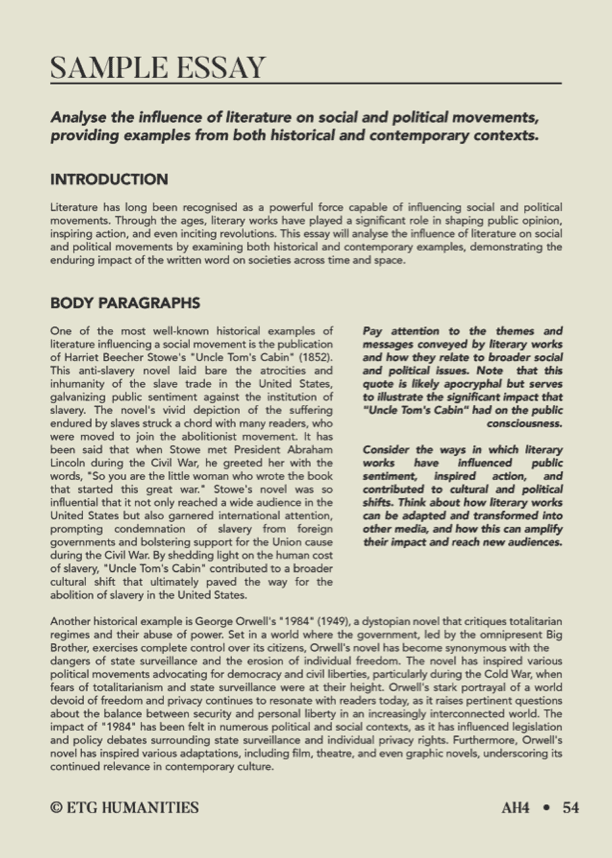
Literature and Social Movements
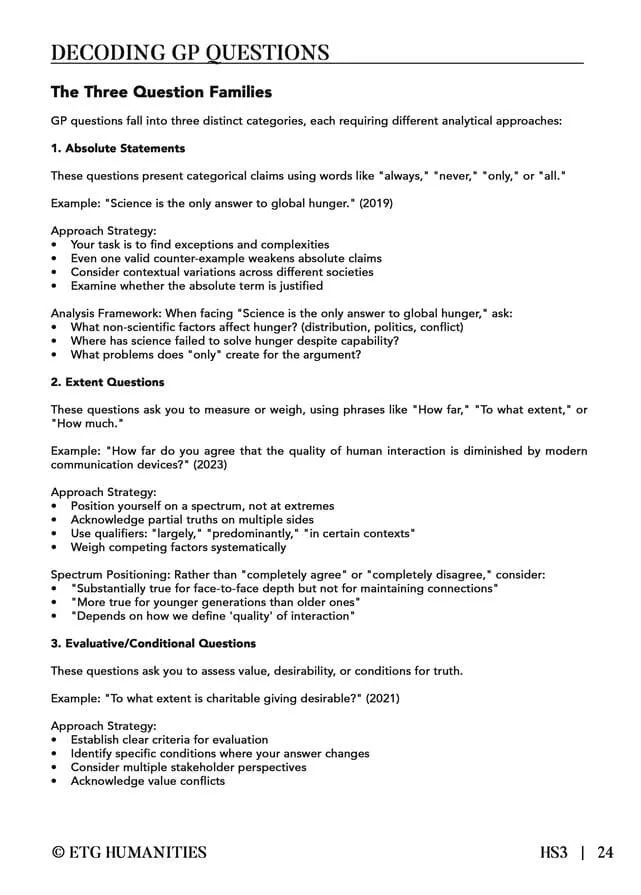
Decoding GP Essay Questions
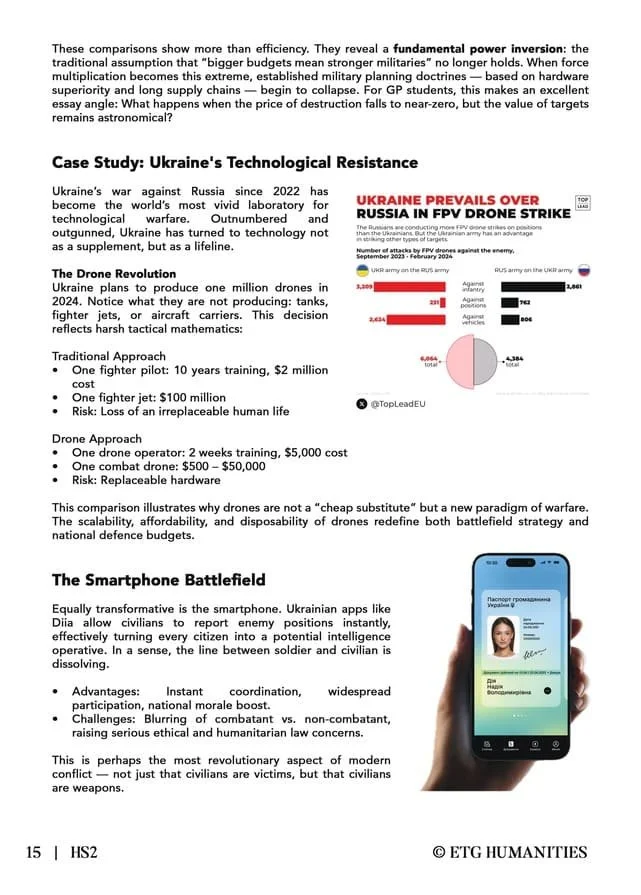
Technology and Modern Conflict
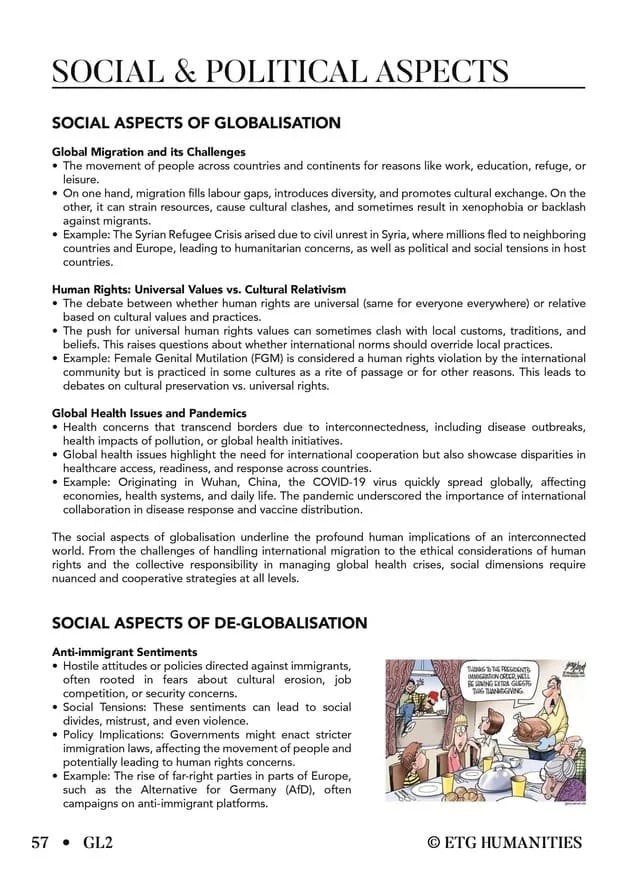
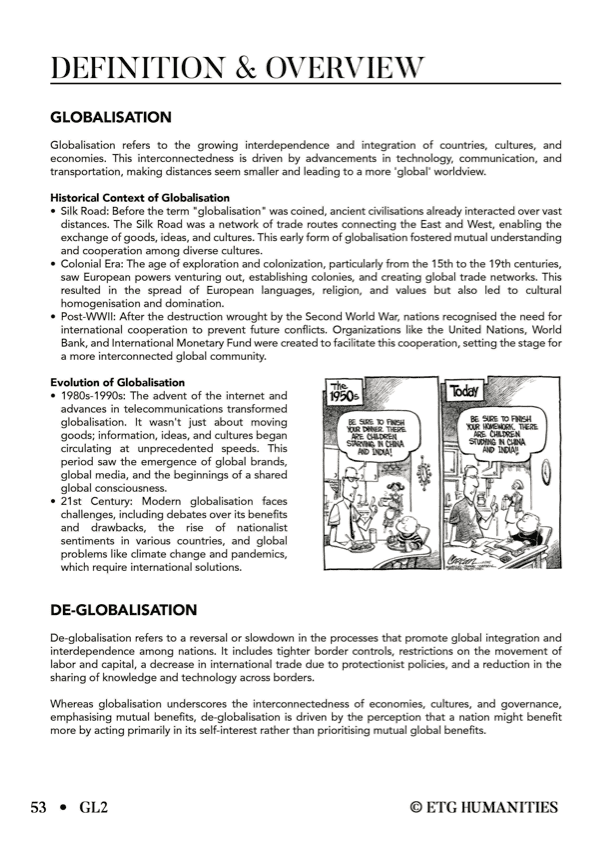
Globalisation and Deglobalisation
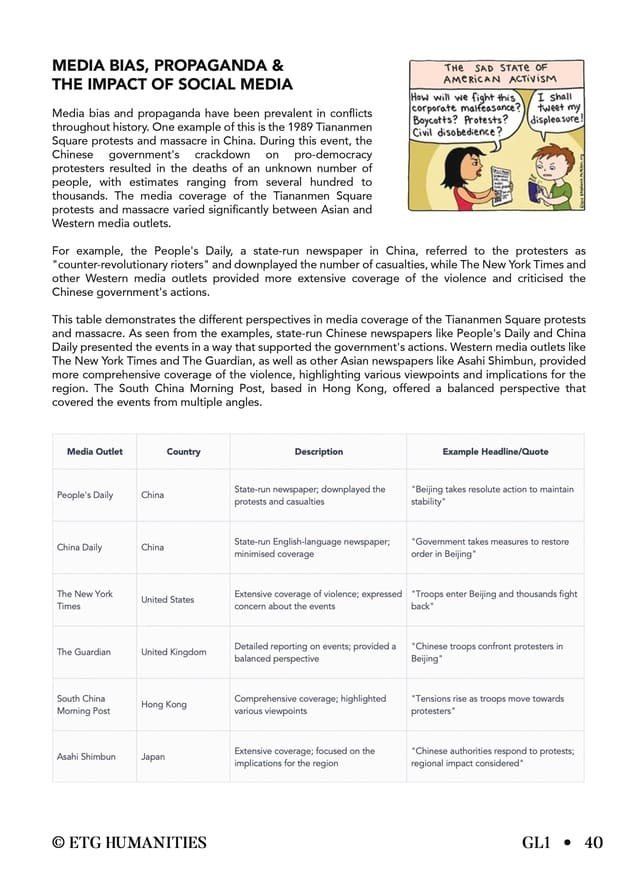
Media Bias and Social Media
Globalisation Overview
$49.90 Listed Price · Per Term

Each textbook is produced for $49.90. You receive every term textbook free as part of GP Expedite.

Most centres distribute photocopied notes packs. ETG GP textbooks are professionally produced, scoped against ten years of past-year question history, drafted through a five-iteration editorial process, and updated every term for current affairs. Joining mid-year, you receive the back catalogue and every subsequent textbook through to JC2.

08 — From Our Students

What the ETG GP programme actually feels like.

The Expedite cohort joins the same live classes, the same crashcourses, and the same teaching as the regular ETG GP cohort. Here is what students from that programme have to say.

A Note on Track Record

Most students in our previous GP cohorts achieved an A or B grade. We do not publish a specific percentage A-rate, because GP improvement is gradual and multifactorial — and an honest framing of the track record is more useful to you than a number taken out of context. The curriculum, the writing volume, and the feedback structure are the evidence we stand behind. The ETG GP programme has been running since 2018 and was opened to full scale in 2026 after eight years of annual refinement.

Still Have Questions?

Speak to our admin team before you commit. No pressure.

09 — Schedule

Locations & timings.

Live JC1 lessons run weekly at Coronation Plaza, Upper Serangoon / Kovan, and Zoom. Choose the slot that works for you — Tuesdays or Fridays.

01

Coronation Plaza

JC1 Friday — 5.00 to 7.00 pm
02

Upper Serangoon / Kovan

JC1 Tuesday — 5.00 to 7.00 pm
03

Zoom — Online

JC1 Tue & Fri — 5.00 to 7.00 pm
10 — Programme Fee

One programme. One price. No further fees.

GP Expedite is a single bundled fee covering live lessons, recorded backfill, every crashcourse, and Term 4 Headstart through to JC2 onboarding. No per-lesson charges. No add-ons.

GP Expedite Bundle
JC1 Mid-Year Programme
$3,080

A single fee. Live lessons, recorded backfill, every crashcourse, Term 4 Headstart — all in.

What's Included

Everything you need to be Promo-ready — and beyond.

  • i.Live weekly JC1 lessonsFrom your join date through Promos and into Term 4.
  • ii.Recorded video backfillEvery chapter since January, accessible immediately.
  • iii.Every term textbookTerm 1A, 1B, Term 2, and every subsequent textbook through to JC2.
  • iv.All eight 2026 crashcoursesMarch (recorded), June (live), September (live).
  • v.Term 4 Post-Promo HeadstartJC1 consolidation and JC2 preview lessons.
−$200 Bundle With Econs Expedite

Taking Econs Expedite as well? Save $100 on each.

Students enrolled in both GP Expedite and Econs Expedite receive a $100 discount on each programme — $200 total. Speak to our admin team to apply the bundle when you register.

💬 Ask About Bundle

Financial assistance is available for students who need it. Speak to our admin team via WhatsApp at +65 8121 6488.

11 — Common Questions

Direct answers. No dodging.

i.

What exactly is GP Expedite, and who is it for?

+

GP Expedite is the complete JC1 General Paper tuition programme, designed for students who join mid-year — typically May, June, or July — and need to be Promo-ready by late September without skipping the JC1 curriculum.

It is a single bundled enrolment that includes live weekly lessons from your join date, recorded video lessons and textbooks for every chapter since January, every GP crashcourse run in 2026, and post-Promo Term 4 Headstart lessons that prepare you for JC2. One programme. One price. The full JC1 programme intact.

ii.

What happens to the lessons I missed before joining?

+

You receive the recorded video lessons for every JC1 GP chapter that ran before your enrolment, plus the corresponding term textbooks (Term 1A, Term 1B, Term 2 — depending on when you join). The recorded videos are the same material the live cohort sat through, captured in full as part of standard programme operations.

You can watch them at your own pace, in any order. Most Expedite students work through the backfill alongside the live lessons over their first few weeks. The textbooks remain useful as references throughout the rest of JC1 and into JC2.

iii.

What does "Promo-ready" actually mean?

+

It means arriving at the JC1 Promotional Examinations in late September having covered the full set of testable themes, written and received feedback on a meaningful volume of essays, completed AQ-specific instruction, and worked through mock Promo papers and the September consolidation crashcourses.

It does not mean a guaranteed grade. GP improvement is gradual and depends on the student's engagement with the practice volume. What we can guarantee is that the structural inputs — lessons, feedback, materials, mock papers — are all in place.

iv.

Are all the crashcourses really included? Even Level 2?

+

Yes — all eight crashcourses we run for the JC1 GP cohort in 2026 are included in the GP Expedite fee. That covers the GP Essentials Crashcourse 1 and GP Skills Crashcourse (March), GP Essentials Crashcourse 2 (June), Level 1 Compre and Essay Bootcamps (June), the September Study Rush, and the Level 2 Compre and Essay Bootcamps (September).

The two March crashcourses, having already taken place, are delivered as the recorded videos plus their textbooks. June and September crashcourses are attended live alongside the regular cohort, in person at the relevant location or via Zoom.

v.

What is the Term 4 Headstart, and why is it part of Expedite?

+

Term 4 Headstart lessons run from October onwards, after Promos. They serve two purposes: consolidating the JC1 syllabus (so what you've learned doesn't fade over the year-end break) and beginning the JC2 themes ahead of the formal JC2 calendar.

Term 4 Headstart is included in GP Expedite because the alternative — finishing at Promos and re-entering the programme in JC2 — would create another gap. The bundle is built so that you do not catch up twice. By the time JC2 starts, you are already integrated into the regular cohort, on equal footing with students who joined in January.

vi.

Can I attend a trial class before committing to Expedite?

+

Yes. You can attend a trial class for any of our regular JC1 GP slots — same lesson, same teaching, same materials as the Expedite bundle's live component. Trial students also receive a previous term's in-house textbook to keep, regardless of whether they enrol.

One thing to keep in mind: GP does not improve after one lesson. The trial is for you to assess teaching quality, lesson format, and curriculum substance — not to be transformed by it. If it meets your standards, the Expedite bundle is the route into the full JC1 programme.

vii.

How does the bundle discount with Econs Expedite work?

+

If you enrol in both GP Expedite and Econs Expedite (the equivalent JC1 bundle for ETG Economics), you receive a $100 discount on each programme — $200 in total off the combined fee.

The two programmes are independent — Econs Expedite is run under a separate ETG sub-brand with its own curriculum, tutors, and track record. You can take either alone, both together (with the bundle discount), or neither. Speak to our admin team via WhatsApp at +65 8121 6488 to apply the bundle when you register.

viii.

What if I miss a live lesson after enrolling?

+

Every live lesson is recorded as part of standard programme operations and made available to enrolled students. If you miss a lesson — illness, school clash, anything else — you can watch the recording at your own pace and stay caught up.

This is the same recording infrastructure that powers the Expedite backfill. It is built into the programme, not a special arrangement.

ix.

Is GP Expedite available online via Zoom?

+

Yes. GP Expedite runs live JC1 classes on Tuesdays and Fridays, 5–7pm, on Zoom — alongside the onsite slots at Coronation Plaza (Friday) and Upper Serangoon / Kovan (Tuesday). The Zoom version covers the same curriculum, same materials, and same feedback as onsite. Crashcourses are also available via Zoom for the relevant dates.

Recorded backfill is delivered digitally regardless of whether you attend live lessons onsite or online.

x.

Why doesn't ETG publish a specific GP A-rate percentage?

+

Because GP improvement is gradual and multifactorial. A published percentage A-rate would be misleading without context — which cohort year, what starting grade, which school, how many lessons attended. Manufacturing a percentage to fill that gap would not serve you honestly.

What we can say is that most students in our previous GP cohorts achieved an A or B grade, across nine cohorts since 2018. The curriculum substance — the textbook quality, the writing volume, the structured programme arc — is the proof we stand behind. The honest framing of our track record is itself the signal.

JC1 GP · In Full · From Wherever You Joined

You've missed time. You haven't missed anything.

One programme. One price. Live weekly lessons, recorded backfill for every chapter since January, every crashcourse, and post-Promo Term 4 Headstart that bridges into JC2. The full JC1 General Paper programme — joined late, intact.

Everything. Covered. GP Expedite · ETG General Paper · Singapore
Register 💬 WhatsApp